
A party budget is easier to manage when you separate costs that change with the guest count from costs that stay almost the same. This guide shows a flexible way to estimate a small home celebration for 10, 15, or 20 guests, with two worked examples, a copyable worksheet, and a simple cost-cutting method.
The practical budgeting formula
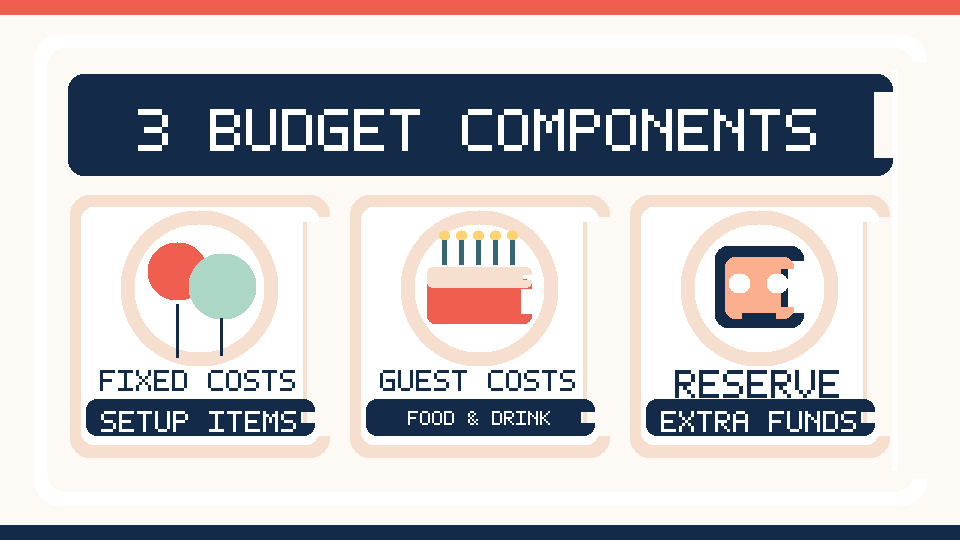
Estimated party spending = fixed expenses + (estimated per-guest expenses × guest count) + a reserve. This is a planning method, not a promise about store prices. Your fixed expenses might include one banner or game, while per-guest expenses often include snacks, drinks, and some serving supplies.
Start with a spending ceiling that fits your finances. Don’t begin by adding every attractive item to a shopping cart. The goal is to design a comfortable gathering within your limit—not to justify spending more.
Step 1: Separate essentials from extras
| Category | Usually essential? | What to check |
|---|---|---|
| Food and drinks | Often yes | Serving plan, allergies, venue rules, safe handling |
| Comfortable seating and access | Yes | Number of seats, clear paths, restroom access |
| Cake or dessert | Depends on event | One shared dessert can be enough |
| Plates, napkins, supplies | Depends on what you own | Reuse available safe supplies |
| Decorations | Optional | One meaningful focal detail often works |
| Activities | Optional | Use a no-cost game or family tradition |
| Unexpected-cost reserve | Strongly recommended | Leave uncommitted money in the budget |
Step 2: List what you already have
Write down usable chairs, a serving tray, pitchers, reusable plates, tablecloths, a speaker if needed, games, and storage containers. Do not count an item as ‘free’ if it still needs to be rented, transported, repaired, or cleaned at an additional cost. This inventory can often reveal your easiest savings.
Step 3: Build a 10-guest worked example
The following amounts are hypothetical U.S. dollar allowances to illustrate the method. They are not measured U.S. price averages, quotations, or recommended vendor fees.
| Expense | Example for 10 guests | Type |
|---|---|---|
| Snacks / simple food | $50 | Mostly varies with guest count |
| Drinks and ice | $20 | Mostly varies with guest count |
| Dessert | $20 | Partly fixed |
| Plates and napkins | $10 | Often varies with guest count |
| Basic decoration | $10 | Mostly fixed |
| Activity / supplies | $10 | Mostly fixed |
| Reserve | $30 | Held back for surprises |
| Total allowance | $150 | $15 per guest |
If your local prices are higher or lower, revise each category. Keep taxes, delivery fees, rentals, and service charges in view; do not assume a quote includes all of them.
Step 4: Compare with a 20-guest worked example
Here is a separate hypothetical plan, not a claim that doubling the guest count doubles every cost.
| Expense | Example for 20 guests | Change to consider |
|---|---|---|
| Snacks / simple food | $100 | Food quantity likely increases |
| Drinks and ice | $35 | Adjust to duration and weather |
| Dessert | $35 | A larger serving quantity may be needed |
| Plates and napkins | $20 | Use or borrow what you have |
| Basic decoration | $15 | Keep one focal design |
| Activity / supplies | $10 | Same simple activity may scale |
| Reserve | $35 | Maintain some flexibility |
| Total allowance | $250 | $12.50 per guest |
Notice that the estimated total rises from $150 to $250 while the per-person figure falls from $15 to $12.50. In this illustration, some costs are shared across more guests. Real-world costs may be different, especially when a larger group requires extra rentals or a different venue.
Step 5: Build a budget for 15 guests
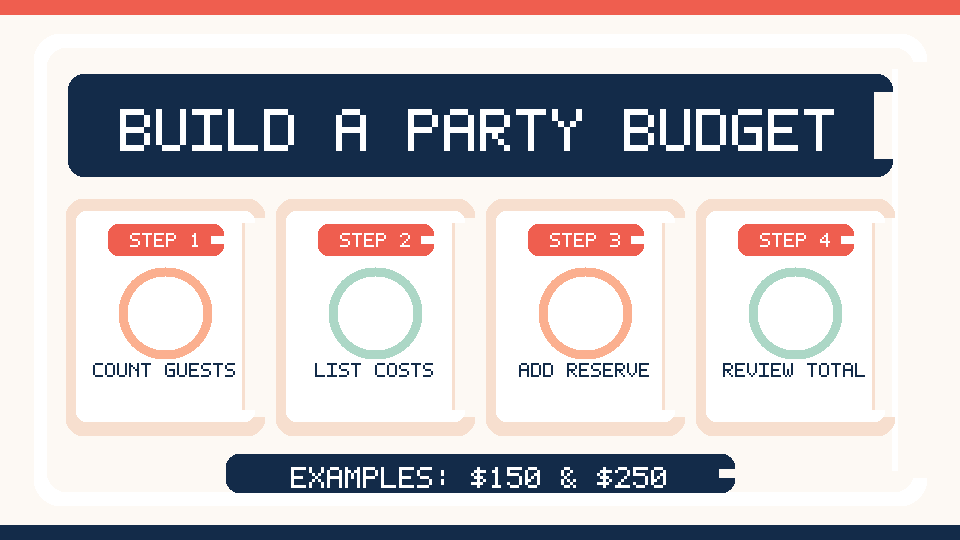
Do not blindly average the 10- and 20-person totals. Instead, review each expense. Estimate food and drink quantities for 15, keep or adjust fixed expenses, ask whether more seating or a second serving table is needed, and then add your reserve.
- Write down your maximum affordable total.
- Make a list of actual items and estimated quantities.
- Use prices from local stores or vendors and include applicable taxes and fees.
- Mark each item essential, optional, or already owned.
- Add a reserve that you do not plan to spend.
- If the result exceeds your maximum, remove optional items first and recalculate.
Copy this simple party budget worksheet
You can copy the following table headings to a notes app or spreadsheet and fill them with local prices. Each item total is the quantity multiplied by its unit price.
| Item | Quantity | Unit price | Calculated cost | Essential? |
|---|---|---|---|---|
| Food | ___ | $___ | $___ | Yes / No |
| Drinks | ___ | $___ | $___ | Yes / No |
| Dessert | ___ | $___ | $___ | Yes / No |
| Serving supplies | ___ | $___ | $___ | Yes / No |
| Decorations | ___ | $___ | $___ | Yes / No |
| Activity | ___ | $___ | $___ | Yes / No |
| Rental / delivery / fees | ___ | $___ | $___ | Yes / No |
| Reserve | 1 | $___ | $___ | Yes |
| Total | $___ |
How to reduce party costs without making it feel cheap
- Choose one focal decoration: A reusable banner or a table centerpiece may be enough.
- Shorten the menu: Offer a clear, manageable set of refreshments rather than many half-used dishes.
- Borrow before renting: Ask trusted friends about chairs or serving pieces, while checking condition and safe setup.
- Choose an off-peak time: A gathering outside main meal hours may support a snack-focused plan, provided guests know what to expect.
- Skip extra games: A simple group activity can be memorable without additional purchases.
- Keep your reserve: A plan that spends its entire budget before the event has little flexibility.
The three costs new hosts often forget
- Taxes, delivery, and service charges. Check the checkout or written quote rather than a display price alone.
- Equipment and seating. A room that holds 20 standing guests may not seat them comfortably.
- Cleanup and food storage. Bags, storage containers, and safe leftover handling require some preparation.
When a home party becomes too expensive
Reconsider the guest count or format before choosing a cheaper option that compromises comfort or safety. A smaller gathering, a shorter duration, or an easy potluck arrangement agreed with guests might better serve your original goal. If you have financial limits, it’s okay to keep celebrations simple and explain the plan clearly.
Frequently asked questions
How much should a party cost per person?
There is no single useful answer for every U.S. location and occasion. Divide your itemized estimate by the guest count to compare scenarios, but review fixed costs and any rentals separately.
Should I include a reserve?
Yes, if it fits your means. Treat it as money held back for unexpected needs rather than an extra decoration allowance.
Can I reuse the worksheet for holidays and graduations?
Yes. Keep the same categories but change guest count, menu, supplies, venue requirements, and timing. For outdoor gatherings, include any reasonable weather backup expenses.
What is the biggest budget mistake?
Buying based on an attractive theme before confirming guests, seating, and food plans. Agree on the comfortable total first, then work backward.
Final takeaway
The best small-party budget begins with a limit, an inventory of what you own, a guest count, and a realistic item list. Compare a couple of scenarios, price items locally, preserve a reserve, and make the extras fit the plan.
Editorial note: All amounts in this article are invented examples for teaching the calculation and are not verified current U.S. prices. Last reviewed October 9, 2026.
Related planning guides: Explore our RSVP guest tracker and at-home birthday party guide for more practical next steps. Visual note: The images in this article are AI-generated illustrative concepts and do not depict an actual event documented by the site.
Keep planning: New to hosting? Visit our Start Here guide for an easy five-step plan, or browse Party Guides for more checklists and practical examples.

