A cookie swap is a festive way to share several homemade treats without every guest baking every variety. For a 10-person cookie exchange, agree on the count and packaging rules before anyone turns on the oven. This guide includes an easy counting example, a sign-up plan, a host budget, a two-hour party schedule, and allergy and food-safety reminders.
What is a cookie swap?
Each participant brings a batch of fully baked cookies, and the group divides the baked goods so guests can take home an assortment. It’s an exchange, not a baking competition. Set a welcoming tone by allowing participants to bring store-bought baked treats or join without baking if the group agrees.
Set the cookie count before sending invitations
Here is a straightforward illustrative 10-person plan: if 10 guests each bring 30 finished cookies, the event receives 300 cookies. If each guest takes home 24 cookies, the group packs 240 cookies in total. That leaves 60 for optional tasting, extras, breakage or hosts’ discretion. Agree in advance on what happens to leftover cookies.
| Count | Calculation | Example result |
|---|---|---|
| Participants | 10 people | 10 |
| Cookies per contributing guest | 30 fully baked cookies | 30 |
| Total cookies brought | 10 × 30 | 300 |
| Take-home quantity | 24 per guest × 10 | 240 |
| Remainder | 300 − 240 | 60 |
The example assumes all 10 guests are contributing the agreed amount and all want a take-home pack. For different guest counts or dietary needs, revise the formula rather than assuming the same number works everywhere. It may be better for a relaxed event to exchange fewer cookies.
How to assign cookie varieties
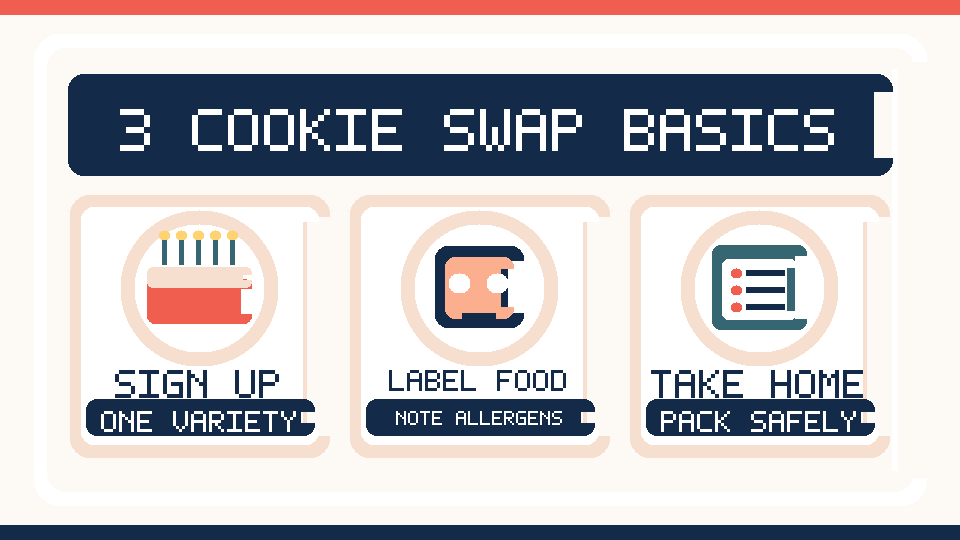
- Invite guests to sign up for one primary cookie style ahead of time.
- Avoid requiring unusual or expensive ingredients; standard recipes are welcome.
- Ask participants to label the cookie name and important ingredients.
- Choose a few options that suit the group’s dietary needs when possible.
- Do not promise that homemade cookies are free from cross-contact with allergens without reliable controls.
Sample sign-up chart
| Contributor | Style | Packaging / label reminder |
|---|---|---|
| Guest A | Chocolate chip | List wheat, dairy, eggs or other actual ingredients |
| Guest B | Oatmeal-style | Note whether oats and other ingredients are appropriate |
| Guest C | Sugar cookie | Mark any glaze ingredients |
| Guest D | Spice cookie | List actual spices and potential allergens |
| Guest E | Chocolate cookie | State any nuts or shared equipment concerns |
| Remaining guests | Other agreed varieties | Confirm quantities and ingredients before the event |
These are examples, not recipe instructions. Participants should use recipes and methods they know work, and clearly communicate allergens and storage needs.
A host-only budget example
The following invented U.S. dollar allowances cover basic hosting supplies and refreshments, not the cookies guests bake or buy. They are not verified prices.
| Item | Sample allowance | Notes |
|---|---|---|
| Nonalcoholic drinks | $20 | Provide water and another option |
| Light savory snacks | $25 | Balance the sweet foods |
| Take-home boxes or bags | $20 | Ask guests to bring reusable containers if possible |
| Labels, pens and tape | $8 | Use existing supplies first |
| Simple decorations | $12 | One seasonal centerpiece |
| Reserve | $15 | Hold back for small needs |
| Host-only total | $100 | Excludes participants’ baking expenses |
A two-week preparation timeline
| When | Host task | Guest reminder |
|---|---|---|
| 2 weeks before | Invite guests and set cookie count | Ask about ingredients and dietary needs |
| 10 days before | Confirm varieties and participants | Avoid unnecessary duplicates |
| 1 week before | Plan containers and serving space | Remind about fully baked cookies |
| 3 days before | Gather label supplies and hosting items | Reconfirm quantities |
| 1 day before | Set up tables and clear kitchen paths | Remind about safe transport |
| Event day | Arrange labeled dishes and packing station | Check storage and handling instructions |
Make the exchange easy to navigate
Create a display area for finished cookies and a separate packing station with clean hands, containers and labels. Invite guests to move around the table in small groups rather than all at once. A third small area for drinks and savory snacks keeps crumbs and spills away from packed cookies.
A relaxed two-hour cookie swap schedule
- 0:00–0:20: Welcome guests and place labeled trays in the display area.
- 0:20–0:45: Sample cookies only when their handling and storage are appropriate; share baking stories.
- 0:45–1:15: Explain exchange quantities and package take-home boxes.
- 1:15–1:40: Enjoy conversation and simple refreshments.
- 1:40–2:00: Pack extra cookies and close with a brief cleanup.
Food safety for homemade cookies
The U.S. Food and Drug Administration advises that flour is a raw food and cookie dough or batter made with raw flour or eggs should not be tasted before appropriate cooking. Clean bowls, utensils and work surfaces after handling raw dough. Bake cookies according to a tested recipe or package instructions.
Storage depends on the recipe and fillings. Cookies containing perishable frostings, custards, cream or other ingredients needing refrigeration should not be treated as shelf-stable solely because the item is called a cookie. Ask bakers to provide storage guidance and transport foods appropriately.
Allergy communication is part of hospitality
Have guests identify the ingredients they used and note any known cross-contact risks. Shared home kitchens and packaging surfaces may not be suitable for a guest with a severe food allergy. If a person has an allergy, discuss an individually safe alternative with them; don’t assume a label eliminates risk.
Packing tips
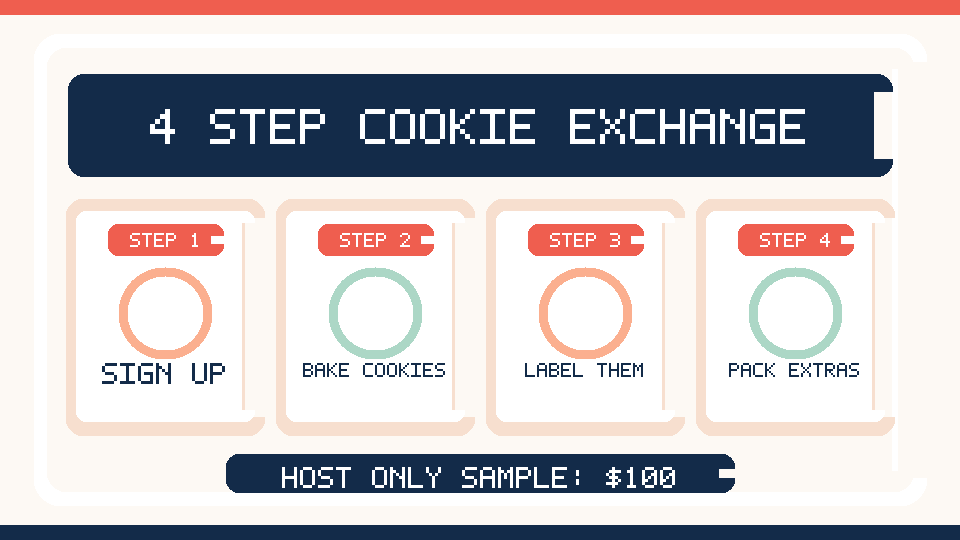
- Use food-safe clean bags, reusable containers or sturdy boxes.
- Provide enough flat room to avoid crushing soft cookies.
- Separate moist, strongly scented or delicate varieties where practical.
- Mark any foods requiring special storage, without inventing a standard shelf life.
- Share the pack-out rule before guests begin exchanging.
Cookie swap checklist
- Confirm the guest list and cookie count agreement.
- Coordinate cookie varieties and known allergens.
- Ask everyone to bring baked treats and ingredient information.
- Prepare clean display and packing tables.
- Arrange safe storage for any perishable cookie fillings.
- Provide clean containers, labels, water and napkins.
- Choose a packing order and take-home count.
- Set aside time for cleaning and handling leftovers.
Common mistakes to avoid
- Not agreeing on quantities: Send a concrete number before anyone bakes.
- Overpromising allergy safety: Ingredient cards do not eliminate cross-contact.
- Assuming every cookie keeps at room temperature: Treat perishable fillings appropriately.
- Making the party too competitive: Prioritize sharing and conversation.
- Leaving packing until the end: Provide enough time and table space.
Frequently asked questions
How many cookies should each person bring?
For a 10-person group, bringing 30 to take home 24 each is one workable arithmetic example. Choose a smaller count if that is more convenient and adjust total expectations together.
Should store-bought cookies be allowed?
That is a decision for the group. Allowing them can be a considerate option for busy hosts or people who cannot bake.
How should cookies with cream fillings be handled?
Follow the recipe’s food-safety instructions and any refrigeration requirement. Don’t leave perishable items on a serving table indefinitely.
Final takeaway
A successful cookie swap depends on clear counts, thoughtful ingredient information, a clean packing station and relaxed expectations. Keep the baking challenge optional and the hosting simple.
Editorial note: All budget figures are hypothetical hosting examples. The 300-cookie sample is arithmetic for a hypothetical 10-person group, not a mandatory portion recommendation. Food-safety details reference FDA guidance reviewed October 9, 2026.
Related planning guides: Explore our gift exchange party guide and potluck sign-up guide for more practical next steps. Image disclosure: The images in this article are AI-generated illustrations of possible setups, not photographs documenting a real event.
Keep planning: New to hosting? Visit our Start Here guide for an easy five-step plan, or browse Party Guides for more checklists and practical examples.

