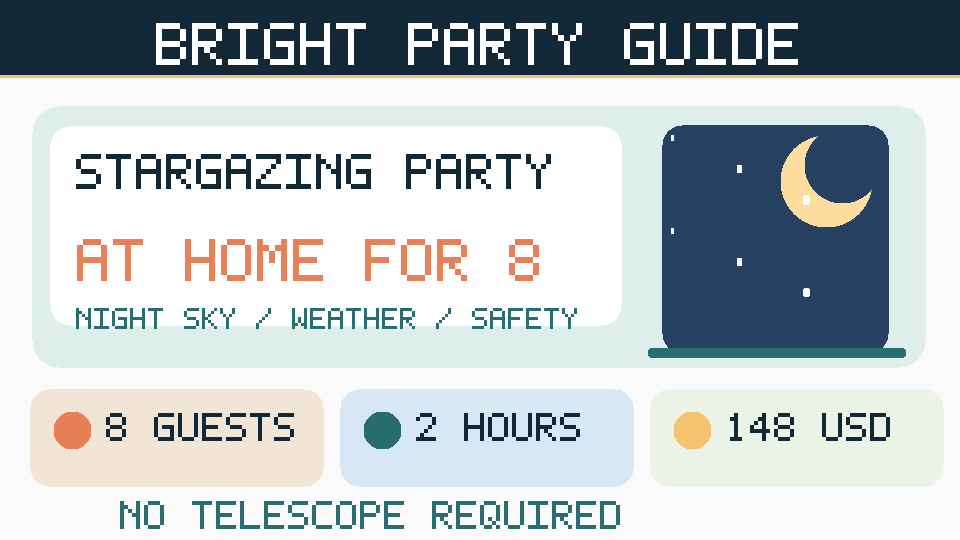
You do not need an expensive telescope or a remote mountain cabin to make a small stargazing evening memorable. A safe, comfortable gathering for eight can focus on what is actually visible from your own yard: the Moon when in view, bright stars, a few constellations or planets depending on season and location. This guide is a beginner-friendly home-party plan, not an astronomical prediction for a particular night. It combines a guest comfort checklist, a realistic $148 sample budget, NASA skywatching guidance, a two-hour schedule, and a cloudy-night backup you can prepare in advance.
Decide whether your location is suitable after dark
Before inviting anyone, visit the observing area in daylight and walk the same route guests will use at night. Look for uneven surfaces, steps, garden tools, hoses, low branches, loose cords and poorly lit entrances. Check seating capacity and the shortest accessible route to a restroom. Do not use a dark field, rooftop, park or other property that is closed or off limits. A backyard may be practical for a small group; a balcony or rooftop is not a safe substitute when it lacks suitable capacity, railings or access.
Set the goal around the sky you actually have
NASA explains that city skyglow makes faint stars harder to see, while Moon brightness and cloud cover also change the viewing experience. Choose one or two broad goals such as identifying a recognizable constellation, watching the Moon if visible, or learning to navigate a sky map. Avoid promising a particular meteor shower or planet before verifying what will be above your horizon on the event date. An interactive sky chart can help guests choose objects visible at their location, but it is not a substitute for checking the sky and forecast.
Build three clear zones without over-lighting the yard
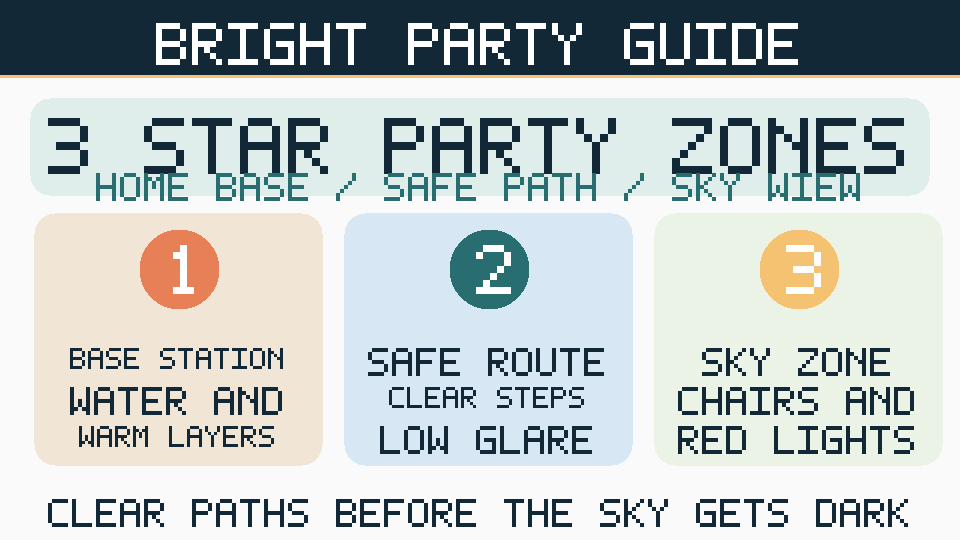
Set up a home-base table where guests can get drinking water, put on layers and view an optional printed sky map. Keep the path to the observing zone clearly marked with safe, low-glare lighting that makes steps visible. In the viewing zone, place stable chairs or blankets away from cords, plants and edges. A red flashlight or red-light setting can help preserve night vision, as NASA suggests, but safety lighting always takes priority over darkness. Keep the nearest exit and bathroom route visible.
Example $148 host budget for eight people
The following figures are hypothetical U.S. dollar allowances, not live local store prices. They assume you already have a permitted viewing area and most of the chairs. Do not buy binoculars solely for one party. Borrow suitable warm blankets or chairs only if they are clean, safe and appropriate for the guests. The reserve can cover real comfort needs, but it is not a requirement to spend the full amount.
| Host budget item | Example allowance |
|---|---|
| Simple snacks | $28 |
| Nonalcoholic drinks | $16 |
| Borrowed seating and comfort supplies | $24 |
| Red-light accessories | $20 |
| Printed sky maps and guides | $10 |
| Bug or weather comfort supplies | $12 |
| Reserve | $38 |
| Illustrative total | $148 |
A 48-hour weather and Moon decision
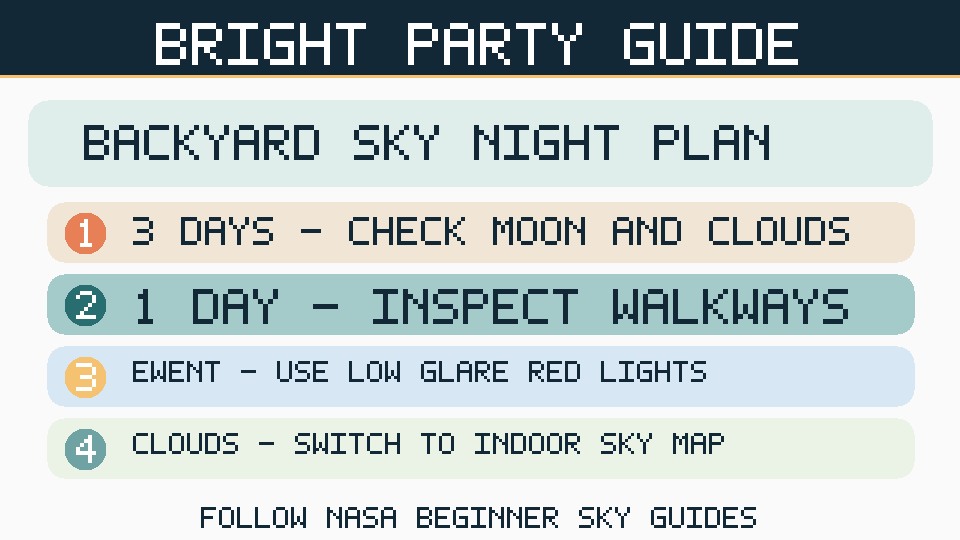
Two days before: check sunset, Moon phase, precipitation probability, wind and temperature for the address of the event. The evening before: determine whether the viewing area remains safe when damp or windy. Two hours before guests arrive: recheck the current forecast and decide whether the event stays outside. If thunderstorms, unsafe cold, extreme heat, smoke, high winds or slippery conditions are expected, move the gathering indoors or reschedule. Do not wait outside to see whether lightning gets closer.
A two-hour plan with time to adapt your eyes
0:00–0:20: arrivals, warm layers, drinks, route briefing and an indoor bathroom check. 0:20–0:40: introduce a sky map and show guests a recognizable direction or constellation using appropriate tools. 0:40–1:25: quiet observing, with breaks for anyone who becomes cold or uncomfortable. 1:25–1:45: optional skywatching questions or a second object, depending on conditions. 1:45–2:00: pack equipment, check the path and conclude. NASA notes that eyes may need around 30 minutes to adapt to a dark sky, so avoid switching bright screens on and off repeatedly.
Prepare an indoor activity for a cloudy night
The fallback should still feel like a celebration rather than a canceled lesson. Use an online sky map, a printed constellation wheel or a short NASA skywatching resource to compare the sky of different months. Ask guests to locate one pattern and explain how its apparent position changes. Invite everyone to share a favorite sky memory, but keep participation voluntary. Confirm the screen and internet connection in advance. A simple quiz with no prizes is enough; a paid planetarium projector is unnecessary.
Offer warm, low-mess refreshments
Provide water and a nonalcoholic warm drink if the weather is cool, plus one shelf-stable snack or a safely handled alternative. Keep hot beverages on a stable table away from blankets, small children and the edge of the observing area. Ask privately about food allergies and mobility needs before shopping. If serving food that needs refrigeration, follow product instructions and the usual perishable food holding limits. Avoid alcoholic drinks that could impair balance or attention while navigating a dark route.
Copy-ready invitation that sets fair expectations
Join us for an easy backyard stargazing night on [date] from [start] to [finish]. No telescope or astronomy experience is needed. We’ll have simple snacks, a sky map and a warm indoor backup if the weather changes. Please RSVP by [date] and let us know privately if seating, accessibility or food needs would make the evening more comfortable. We’ll share the address and parking details directly with confirmed guests. We’ll confirm the weather decision by [time].
Accessibility and neighbor comfort count more than darkness
Not everyone can comfortably stand still, sit on a blanket or move on uneven ground. Provide stable chairs and a direct accessible route wherever possible. Offer an indoor sky-map option to guests who prefer not to be outside. Keep music and voices within local quiet-hours rules and avoid pointing lights toward neighbors’ windows. Ask before photographing people or publicly sharing the address of the gathering. A night can be memorable even if only a few bright stars are visible.
What not to promise guests about telescopes and celestial events
Do not advertise a specific planet, meteor shower, eclipse or constellation without checking the actual date, local sky and weather. Binoculars or a telescope are optional for ordinary nighttime observing. Never use ordinary binoculars or an unfiltered telescope to look at the Sun, even for a moment. Specialized certified solar viewing equipment and appropriate procedures are separate from this night-party guide. If a guest brings a telescope, keep tripods stable and avoid allowing curious children to move equipment without supervision.
After-party checklist and useful lessons
Collect maps and red-light accessories, return borrowed blankets, check that nobody has left equipment on a walkway, and dispose of drinks and food safely. Record the actual number of attendees and whether extra layers or chairs were needed. Instead of rating the party by the number of stars seen, ask what guests enjoyed: learning one constellation, a relaxed conversation or the indoor sky map. The next party can improve without a major new purchase.
Frequently asked questions
Can we stargaze from a city backyard? Yes, although bright lights may limit faint objects; set modest expectations. Do we need telescopes? No; NASA suggests naked-eye viewing and sky maps as useful starting points. Should every guest bring a flashlight? Not necessarily, but routes must remain safe; red light can help reduce glare. What if it rains? Use the planned indoor sky activity or reschedule. Is a full Moon a bad thing? Bright moonlight can obscure faint stars but the Moon itself may be a good observing subject when appropriate.
Why Bright Party Guide treats this as a real hosting problem
An effective stargazing party depends on safe paths, guest comfort, honest sky expectations and a ready backup—not a promise of spectacular photographs. The sample budget and three-zone layout are designed for first-time hosts who want to enjoy the company of eight guests while learning a small piece of the night sky.
Copy-ready host checklist
- Confirm 8 guests and seating preferences
- Inspect dark paths and accessibility in daylight
- Check NASA sky resources and the actual local Moon and forecast
- Prepare red lights without making steps unsafe
- Borrow chairs and layers before buying anything
- Have an indoor sky-map plan for clouds or storms
- Confirm an end time that respects neighbors
Official references and related planning guides
References: NASA: Skywatching FAQ; NASA: Beginner Stargazing Notes. Verify relevant conditions before hosting.
Continue planning: Backyard party and weather plan; Small apartment party layout; Party budget worksheet; Start Here; Browse all guides.
Editorial and illustration note: All amounts, quantities and schedules are hypothetical planning examples, not documented events, verified local prices or guaranteed results. The images are original illustrated concepts and information graphics, not photos of an actual hosted gathering. Published October 11, 2026.

