
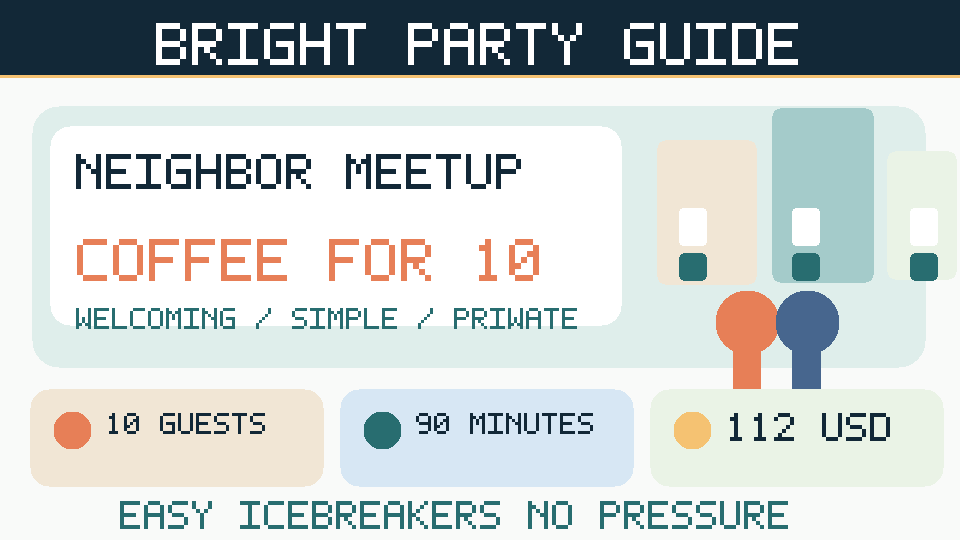
A small neighborhood meet-and-greet is a low-pressure way to put faces to nearby names, welcome newcomers or help neighbors find shared interests. It should not become an obligation to share private phone numbers, explain where you live in detail or participate in awkward games. This guide assumes ten total attendees, including the host, and a ninety-minute home gathering with coffee, decaf or tea, water and a few snacks. The example $112 budget and three-zone layout can be adapted for a community room or another permitted meeting location.
Clarify who is invited and what the gathering is for
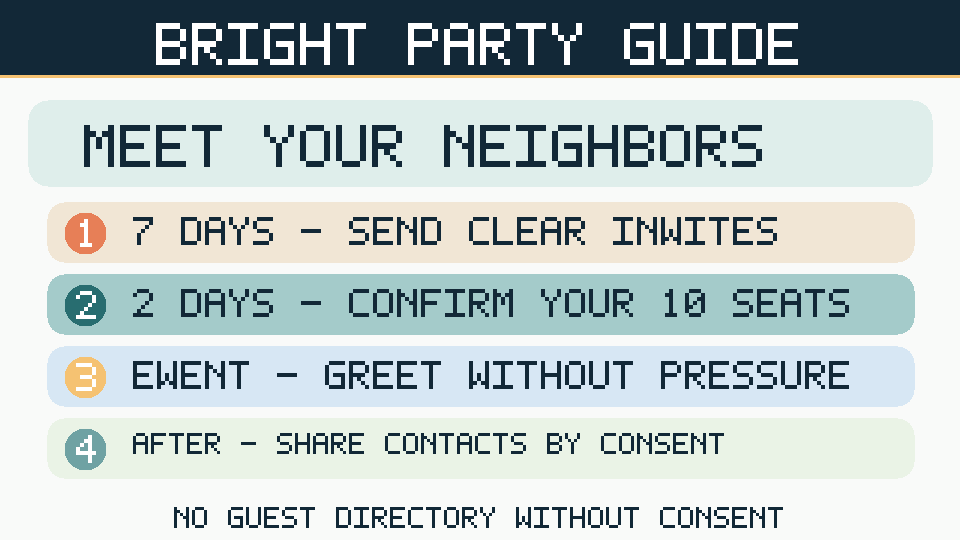
Decide whether the event is for one building, a block, a shared courtyard or a particular group of nearby households. Be explicit that this is a casual social welcome, not an official homeowners association meeting, security screening or request for donations. If you are inviting neighbors you have not met, use a respectful individual message or a permitted community bulletin rather than collecting addresses or private data from other residents. Do not imply that attending is required to be part of the community.
Set a realistic ten-person capacity
Count yourself and any co-hosts in the ten-person total. Provide ten suitable seats or a mix of safe seating and standing space that genuinely meets the guests’ needs. Check easy access to the restroom, daylight, ventilation and a stable place for hot drinks. A quiet space with a small table is often more comfortable than loud music and elaborate decorations. If demand exceeds the room’s capacity, set up a second session rather than squeezing people into hallways or blocking exits.
Make invitations informative without oversharing
Include the date, a ninety-minute window, general location and RSVP deadline. Share the exact apartment number or entry instructions privately only with people who have confirmed attendance. Avoid putting door codes, access details or another person’s mobile number on public posters. Offer a clear way for guests to raise mobility, dietary or comfort needs privately. An optional ‘come for only ten minutes’ note can help those who are interested but busy.
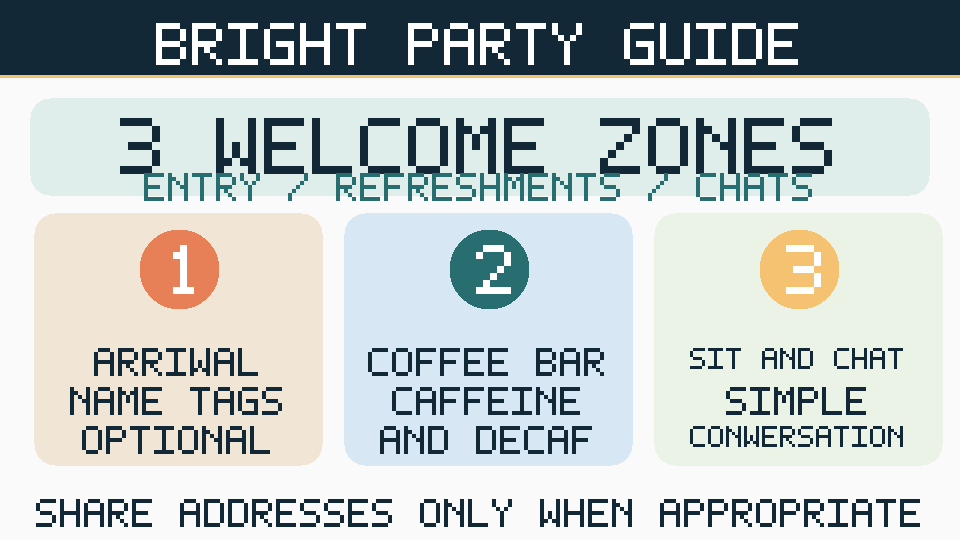
Build three zones for easy conversation
Set one welcome spot with optional first-name labels and a place to leave a coat. Put coffee, decaf, tea, water and light snacks on a separate stable refreshment table; position hot liquids away from children and tight traffic routes. Arrange a conversation zone with small clusters of chairs so guests can talk without performing for the whole room. Make it easy to move between a quiet group and a livelier conversation. No one should need to wear a name tag to be welcome.
A hypothetical $112 coffee-host budget
This is an illustrative U.S. dollar allowance for simple refreshments and basic supplies, not a live café or grocery quote. Borrow cups or use existing washable mugs where practical. Keep a small reserve in case an extra caffeine-free option or basic accessibility supply is needed. There is no need to buy custom party favors, printed banners or paid icebreaker cards.
| Host budget item | Example allowance |
|---|---|
| Coffee and regular tea | $22 |
| Decaf and caffeine-free options | $12 |
| Simple baked snacks | $24 |
| Fruit | $18 |
| Accessible basic hosting supplies | $9 |
| Optional first-name labels | $7 |
| Reserve | $20 |
| Illustrative total | $112 |
Use a ninety-minute schedule instead of forced introductions
0:00–0:15: greet arrivals individually, indicate the drinks and restrooms, and offer optional name labels. 0:15–0:25: say a brief welcome that explains the gathering is casual and that conversation is optional. 0:25–1:05: let pairs or small groups chat; provide a few simple question cards if desired. 1:05–1:20: offer a closing prompt such as local hobbies, volunteering interests or favorite public spaces, without requiring answers. 1:20–1:30: wrap up, clean up and thank people for joining.
Three easy conversation starters that protect privacy
Ask ‘What’s a local park or café you enjoy?’ or ‘What kind of community event would you love to see?’ or ‘Have you read or watched something fun lately?’ These give neighbors something to share without asking their work schedule, family income, exact apartment, children’s schools or immigration background. Allow participants to decline questions or simply listen. Do not make a guest feel conspicuous because they are new, shy, older, younger or from a different background.
Copy-ready neighborhood invitation
Hello neighbors! I’m hosting a small, informal coffee meet-and-greet for about ten people on [date], from [start] to [finish]. We’ll have coffee, decaf or tea, water and a few snacks. It’s simply a chance to say hello and chat; no special preparation, gifts or donations are expected. Please reply by [date] if you’d like to join. I can send the exact location privately, and you may share any access or dietary needs with me privately as well.
Offer refreshments without excluding anyone
Make water the easiest option to find, and offer decaf or caffeine-free tea for guests who prefer to avoid caffeine. Ask about food allergies and check ingredient labels; do not promise an allergen-free home without controls. Choose snacks that are easy to hold and do not require guests to balance a hot drink and plate while standing. Use clean serving utensils and refrigerate any perishable dairy or cut-fruit ingredients appropriately. Coffee and tea are hospitality options, not reasons to pressure guests to eat or drink.
Respect contact information and photos
Never assume that joining a gathering means permission to add someone to an email list, group chat or public directory. If guests wish to stay in touch, let them exchange details directly or offer a separate explicit opt-in with a clear explanation of what will be shared. Do not take or post group photos without consent from identifiable people, and do not announce other residents’ addresses or schedules. Delete private RSVP details once they are no longer needed for legitimate hosting purposes.
Keep neighborhood differences out of the way
Guests may have different work hours, political views, ages and ideas about community life. Set a simple tone: everyone is welcome to be polite, nobody has to agree on every topic, and nobody will be pressured to volunteer or contribute money. A first gathering works best when it is short and accessible rather than trying to solve every neighborhood issue. If a disagreement arises, redirect to an ordinary social topic and suggest discussing any formal complaint in the appropriate forum.
Follow-up that doesn’t become spam
Send an individual thank-you if you have permission to contact the person. If there is interest in another gathering, suggest a date without automatically creating a recurring mailing list. Return borrowed mugs, clean refreshments and check whether there were accessibility issues that can be fixed next time. The best measure of success is whether the meeting felt comfortable and voluntary—not how many phone numbers the host collected.
Frequently asked questions
Should people wear name tags? Make them optional and limited to a preferred first name. Is ten people enough? It is a practical size for one room, and two smaller sessions may work better than a crowd. Can I post my door code on a shared flyer? No; give sensitive entry details privately. Do I need games? No; short conversation prompts are plenty. May I create a neighborhood group chat after the party? Only when members have explicitly opted in to the intended group and sharing of their details.
Why Bright Party Guide treats community gatherings differently
A meet-and-greet is successful when newcomers can participate on their own terms. This plan places comfort, privacy and straightforward communication before decorative themes or noisy group games. The modest budget, ninety-minute schedule and three-zone layout make hosting approachable while giving guests control over what they share.
Copy-ready host checklist
- Confirm ten people including hosts and suitable seating
- Send polite invitations with a clear RSVP deadline
- Share exact address and entry details only as appropriate
- Prepare water, coffee, decaf or tea and labeled snacks
- Set optional greeting, refreshment and small-group chat zones
- Obtain consent before sharing photos or adding contact details to a group
- Finish after ninety minutes and follow up only with permission
Official references and related planning guides
References: FoodSafety.gov: Four Steps to Food Safety. Verify relevant conditions before hosting.
Continue planning: Small housewarming party; Low-waste home party; RSVP tracker and polite reminders; Start Here; Browse all guides.
Editorial and illustration note: All amounts, quantities and schedules are hypothetical planning examples, not documented events, verified local prices or guaranteed results. The images are original illustrated concepts and information graphics, not photos of an actual hosted gathering. Published October 11, 2026.

