
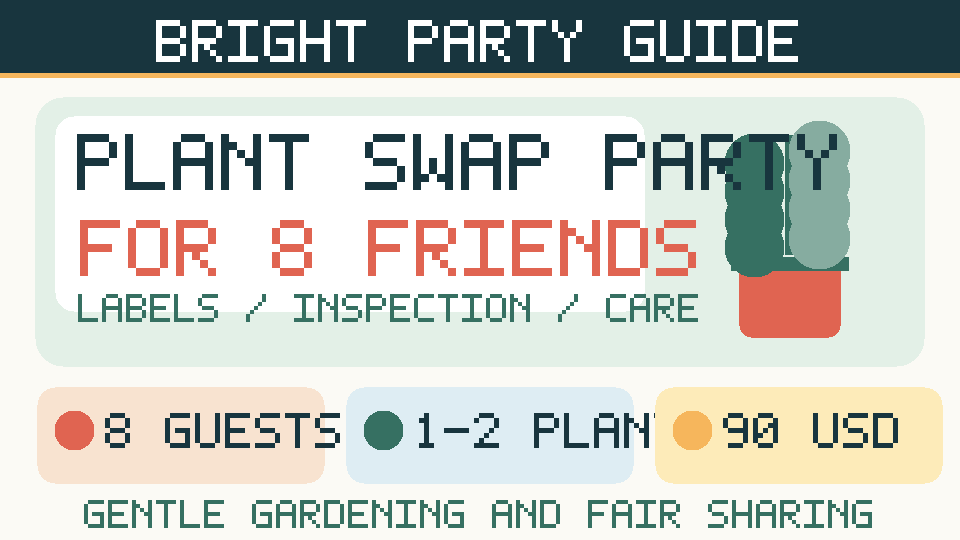
A plant swap can turn an ordinary afternoon into a useful exchange of houseplants, cuttings and practical growing knowledge. It is also one event where the condition of an item matters more than the decorations: a mislabeled cutting, visible pests or unsuitable species can cause problems long after guests leave. This guide covers an eight-person gathering, a limit of one to two plants per contributor, basic labeling, a fair picking process and a hypothetical $90 host budget. It is a party-hosting guide, not a guarantee that a plant is healthy, safe for pets or legally transferable in every location.
1. Invite people with clear species and condition rules
Ask guests to bring one or two rooted, contained plants or clearly identified cuttings they own and are permitted to share. Require guests to identify the species as accurately as possible; an unknown plant should be marked unknown rather than given a guessed name. Avoid collecting wild plants without permission or transferring prohibited, protected or invasive species. Check your local agricultural requirements and any restrictions when guests would move plants across state or national boundaries.
2. Calculate the table capacity before the guest list expands
With eight contributors bringing one plant each, the first possible inventory is eight. If all eight bring two, it becomes sixteen. That is only an expected range, because some guests may attend without a plant and some contributions might not pass the agreed inspection. Plan enough tabletop area for sixteen small pots, plus a separate quarantine or decline station away from the exchange. Do not crowd plants together where soil spills, pests or broken leaves can move easily between them.
3. Every contribution needs a meaningful care card
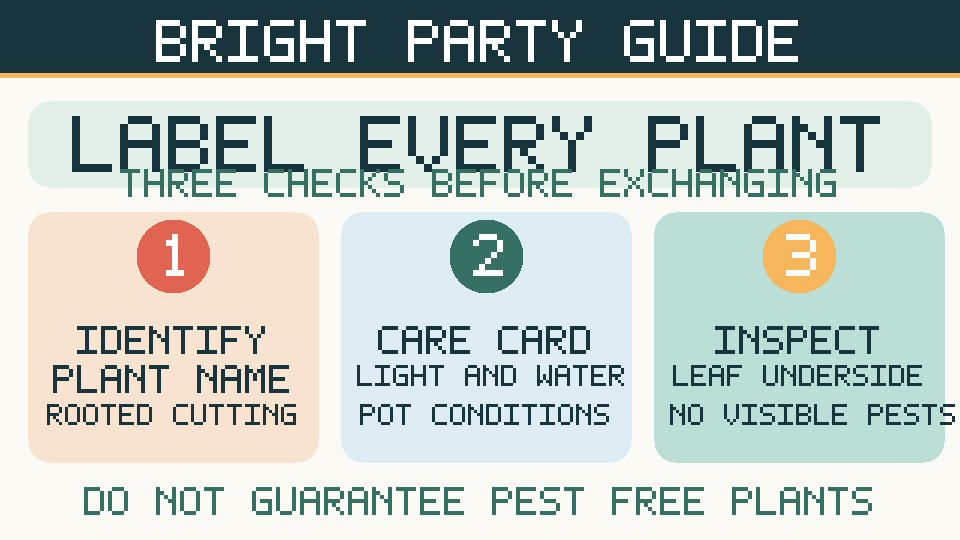
Write the plant name or ‘species not confirmed’; whether it is a rooted plant or cutting; suggested light conditions; known watering preferences; and the current potting medium if relevant. Leave room for a question mark when a detail is not verified. Optional notes can mention whether the parent plant grew indoors and whether the item was recently repotted. Make labels large enough to read on a phone or tabletop. A care label is helpful history, not a promise that the plant will thrive in a new home.
4. Check for visible pests before any swapping begins
Ask guests to inspect their plants in advance and again at check-in. Look over leaves, leaf undersides, stems, soil surface and the container for insects, webbing, sticky residue, discoloration or unusual damage. A plant that shows a possible infestation should not join the main table. Not finding visible pests does not prove a plant is pest-free. University of Minnesota Extension recommends carefully inspecting houseplants and separating newly acquired plants for about one to two weeks to observe possible pest issues. Explain this in the invitation so nobody is surprised.
5. Use a genuinely fair exchange rule
Give one exchange ticket for each acceptable plant, up to two tickets per participant. Conduct one initial selection for each contributor before allowing second picks. Visitors with no plants can still join the social event and ask care questions, but should not be promised exchange plants ahead of contributors unless the group chooses a different model in advance. If an owner withdraws a plant before acceptance, do not issue a ticket. Discuss unclaimed plants directly with their original owners rather than silently taking or discarding them.
6. An illustrative $90 host budget
These amounts are a simple U.S.-dollar planning example, not a quote for plants or supplies. Participants bring their own plants voluntarily, and nobody should have to buy a rare specimen to attend. Use washable surfaces, reusable trays and the supplies already available. The host reserve covers spills or extra labels, not an obligation to purchase replacement plants.
| Host expense | Hypothetical allowance |
|---|---|
| Washable table covering | $12 |
| Care-card labels and markers | $8 |
| Spare trays and pot sleeves | $14 |
| Cleanup and protective supplies | $12 |
| Water and nonalcoholic drinks | $18 |
| Light refreshments | $12 |
| Reserve | $14 |
| Illustrative host total | $90 |
7. Organize three stations and protect the room
Create a check-in and inspection spot near an easy-to-clean surface, a swap table with plant labels facing forward and a packing area with spare sleeves or small boxes. Keep soil and wet containers away from food and electronics. Provide washable table protection and a small trash bin for paper and packing material. Offer enough room for guests with mobility devices and avoid placing pots where they block walkways. Arrange the refreshment station separately from plants and any soil-based tools.
8. A two-hour schedule with time for care questions
0:00–0:20: arrivals, labels and check-in inspections. 0:20–0:40: guests introduce their plants and share growing conditions they actually know. 0:40–1:05: first fair choosing round. 1:05–1:25: second round if tickets and plants remain. 1:25–1:45: optional care-card discussion and packing. 1:45–2:00: owners reclaim leftovers or explicitly choose another destination; wipe surfaces and check for spills. Avoid rushing guests to choose unknown plants just to end on time.
9. An invitation that prioritizes plant wellbeing
You’re invited to a relaxed houseplant swap at my home on [date], [start–finish]. If you would like to exchange plants, bring one or two labeled, contained houseplants or cuttings that you own and can share. Please inspect them for visible pests and unusual symptoms before coming. You are welcome to join for conversation without bringing a plant. We’ll use one ticket per accepted plant and check local transfer rules if applicable. RSVP by [date], and let me know privately about any access needs.
10. What new owners should do at home
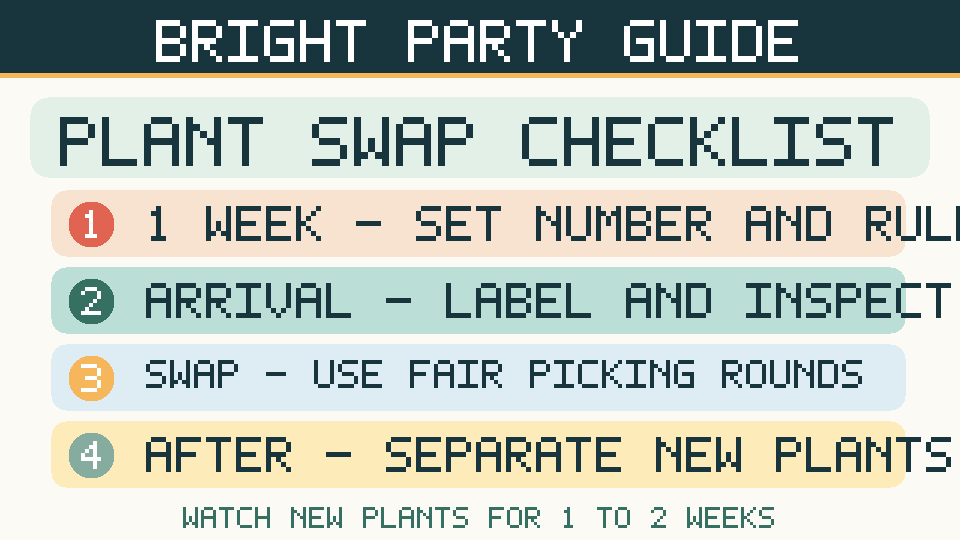
Transport pots upright in a box or tray that catches spills. Keep new plants separate from established houseplants for one to two weeks as recommended by University of Minnesota Extension, observing leaves, stems and potting media for signs of pests. Read the care notes but adjust slowly to the new space rather than watering or fertilizing automatically on arrival. Research a plant’s toxicity before placing it where children or pets can reach it; do not assume every decorative houseplant is harmless.
11. How to handle pests, unknown varieties and leftovers
For a plant that may be infested, explain the concern privately and decline it from the shared exchange area. Do not spray chemicals at the party or offer improvised pesticide treatment. For an unidentified plant, encourage research and voluntary refusal instead of presenting a false species label. For leftovers, record whether the owner wants the plant returned, offered free to guests or taken to an authorized recipient. Treat photographs of guests and their homes as private unless they agree to sharing.
Frequently asked questions
Can people bring leaf cuttings instead of potted plants? Yes if the exchange rules explicitly allow them, and the cutting is identified and protected; make clear whether it has roots. How many plants could eight people exchange? Eight to sixteen is the starting range if every contributor brings one or two acceptable plants; the actual amount may be lower. Are all plants safe for pets? No; assess each species separately before bringing it into homes with animals or children. Is one week of separation enough? University of Minnesota Extension recommends approximately one to two weeks of observation for newly acquired plants; the duration does not guarantee freedom from all pests.
Why this is more than a decorative plant party
A practical swap protects the recipient and the contributor by explaining condition, labels, fair choosing rules and what happens to leftovers. Guests leave with care notes and realistic expectations, not just a pretty photo of eight pots. The sample budget, inventory range and inspection flow are designed to work in ordinary living rooms, even when no one buys new plants.
Copy-and-use host checklist
- Tell eight invitees the one-to-two-plant limit
- Check local plant transfer rules and encourage species identification
- Set aside table space for up to sixteen small plants
- Prepare readable light, water and rooting-status labels
- Inspect leaves and containers before issuing swap tickets
- Run first round before second picks; confirm leftover permissions
- Ask recipients to keep new plants apart from existing plants for observation
Sources and further planning tools
Official reference: University of Minnesota Extension: Managing insects on indoor plants. Use the source guidance for safety and plant care; local conditions and regulations may differ.
Explore related guides: DIY craft party for eight; Housewarming party guide; RSVP guest tracker. New to hosting? Start Here and browse our Party Guides.
Editorial and illustration note: The planning examples, prices, quantities and timing are hypothetical and should be adjusted to actual guests and local conditions. Illustrative diagrams are original planning artwork, not documentary photos of a real party. Article prepared October 11, 2026.

