
A book swap party helps friends share favorite reads without making anyone spend money on a new gift. The difference between a friendly exchange and a frustrating one is agreeing on the rules before guests arrive. This guide uses ten attendees, one to three books per contributor, a clear one-book-one-ticket method and a simple two-hour event schedule. It also explains what to do when books have different conditions, someone brings none, or books are left unclaimed. The example is for legally owned physical books being voluntarily exchanged at a private gathering.

1. Decide whether this is a swap, giveaway or social book club
A swap should give contributors a fair chance to take home books. A giveaway is different: people may browse without contributing. A book club focuses on discussing a shared book and does not require exchanging it. Choose one format and say it plainly in the invitation. This sample uses a structured swap for up to ten people, with a separate free-browse option for leftover books only when the original owners approve. That prevents guests from assuming every book is free to take.
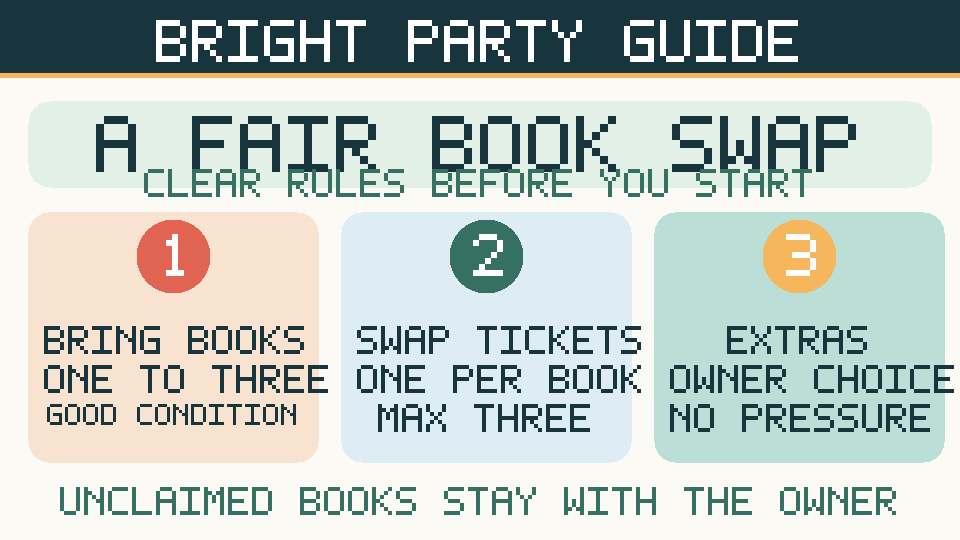
2. Announce the one-to-three-book limit early
Ask interested guests to bring one, two or three clean, legally owned books they are comfortable letting someone else keep. A visitor may come without books to socialize; do not embarrass them or promise them access to the early swap rounds. If all ten people bring three books, the maximum example inventory is 30. If each brings one, only ten are available. The actual number depends on confirmed contributions, so do not order forty table labels before counting responses.
3. Use a transparent one-book-one-ticket system
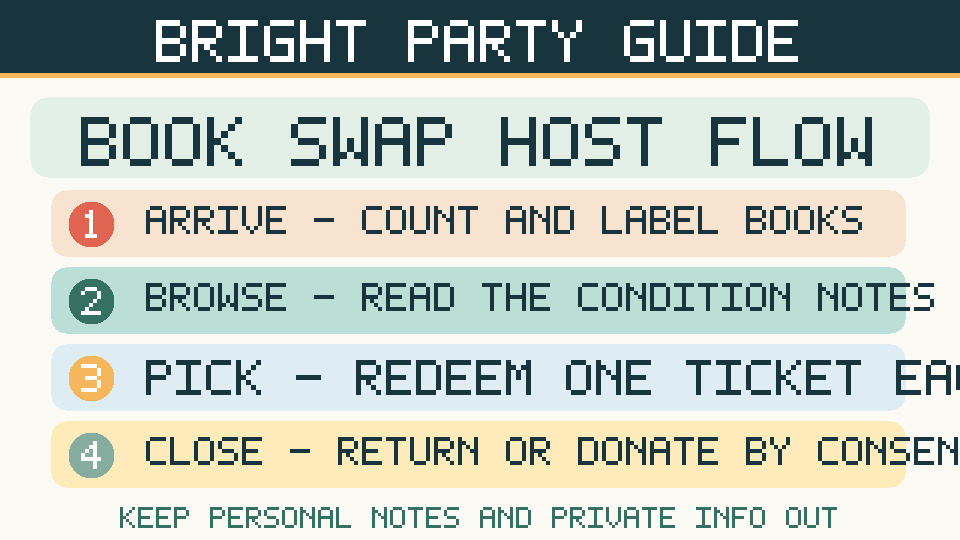
At check-in, accept each qualifying book and issue one ticket per accepted book, capped at three tickets per person. Guests spend one ticket each time they select a book. For fairness, run the first browsing round with a limit of one selection per contributing participant before allowing additional choices. If someone brought three books, they may choose up to three when inventory remains. Explain how disputes, duplicate favorites and any unused tickets will be handled before the tables open. Participation is voluntary, and hosts should not secretly hold desirable books aside.
4. Set simple condition and content rules
Accept clean, dry copies with complete pages and no obvious mold, pests or strong odors. Light highlighting or wear may be fine if clearly disclosed and the receiver agrees. Mark damaged books honestly rather than hiding flaws in a decorative cover. Agree in advance whether textbooks, children’s books, large-print editions, heavily annotated books or current reference guides are welcome. Consider a visible ‘please check edition and condition’ label. Do not collect guests’ personal notes, addresses or phone numbers left inside books.
5. An illustrative $68 host-only budget
The figures below are examples of what a host might spend on light refreshments, labels and carry bags—not actual prices from a local store. A true book swap does not require attendees to buy books. If supplies exceed the budget, borrow trays and use paper labels; avoid turning a low-cost social evening into a shopping event.
| Host expense | Hypothetical allowance |
|---|---|
| Simple snacks | $20 |
| Nonalcoholic drinks | $18 |
| Paper labels and pens | $6 |
| Protective bags and supplies | $10 |
| Table covering or repair supplies | $4 |
| Reserve | $10 |
| Illustrative host total | $68 |
6. Arrange drop-off, browsing and pickup areas
Use one entrance drop-off spot where guests can count books and receive tickets without blocking a door. Put books on one or two stable tables grouped by broad category: fiction, nonfiction, children’s titles and other. Do not stack books high enough to topple. Place a smaller checkout zone where tickets can be counted. Keep drinks and crumbs on a different table so the books remain dry. Provide enough light to read titles, and do not put tall piles on a narrow hallway shelf.
7. Send an invitation that explains the real rules
You’re invited to a relaxed book swap at my home on [date], [time]. Please bring one to three clean books you own and would happily exchange. Each accepted book earns one ticket, and the first round allows one pick per contributor. You are welcome to come just to chat even if you have no books. Please RSVP by [date] and ask me privately about accessibility or food needs. Unclaimed books will be offered back to their original owners unless they approve another plan.
8. A two-hour schedule that avoids a rushed grab
0:00–0:20: greet guests, inspect and count contributions, and issue tickets. 0:20–0:35: let everyone browse titles without claiming them yet, and explain condition labels. 0:35–0:55: one-book first round in a fair order agreed in advance, such as drawing numbers. 0:55–1:20: additional rounds for unused tickets while books remain. 1:20–1:45: drinks, conversation and book recommendations. 1:45–2:00: return remaining books or discuss optional donation with owners and clean up. Guests who leave early can use a host-assisted turn by prior agreement.
9. Handle leftovers ethically and without surprises
At the beginning, decide whether unclaimed books stay with their contributors or may be donated with explicit permission. Do not assume that placing a book on the swap table is permission for a host to sell, recycle or publicly give it away afterward. Keep the contributor’s small removable name slip separate from the display when possible; it can help return items without publishing identities. Find a willing local recipient before promising donation. Check acceptance rules and condition requirements rather than dropping boxes at a closed donation center.
10. Make the swap welcoming beyond genre preferences
Invite guests to share a one-sentence recommendation without revealing spoilers. Provide categories and, if useful, a designated shelf for books with larger text or audiobook recommendations without promising physical copies. People who dislike competitive picking may prefer a quiet preview period. Avoid imposing reading tastes or asking guests to explain why they choose a particular title. A book may be emotionally meaningful to its owner; make it easy to withdraw a book before the ticket is issued.
Frequently asked questions
Can someone join without bringing a book? Yes for conversation, but early exchange rounds should follow the published rules. What happens if a book is damaged? Disclose the condition; the host may decline it if it fails the agreed criteria. Should everyone take home the same number they brought? That is the goal of a ticket-based exchange when enough acceptable books remain, not a guarantee of preferred titles. Can we include borrowed library books? No—bring only books the participant legally owns and can transfer.
Why a clear rule sheet matters
A good book swap has three separate promises: guests know what to bring, books can be selected in a fair order, and contributors control leftover items unless they consent to another outcome. This is more useful than a generic party list because the operating rules make the activity work even when individual preferences differ.
Copy-and-use host checklist
- Agree on one to three clean books per contributor
- Explain one ticket per accepted book and max three tickets
- Prepare category tables and a separate drink area
- Check conditions and issue tickets privately at arrival
- Let every contributor select one book in the first round
- Run additional rounds based on unused tickets
- Return leftovers unless owners explicitly authorize donation
Sources and further planning tools
Explore related guides: Gift exchange party rules; DIY craft night for eight; Party RSVP tracker. New to hosting? Start Here and browse our Party Guides.
Editorial and illustration note: The planning examples, prices, quantities and timing are hypothetical and should be adjusted to actual guests and local conditions. Illustrative diagrams are original planning artwork, not documentary photos of a real party. Article prepared October 11, 2026.

